
IC vs EM Way of Agentic Programming
There are two main ways of doing agentic programming.
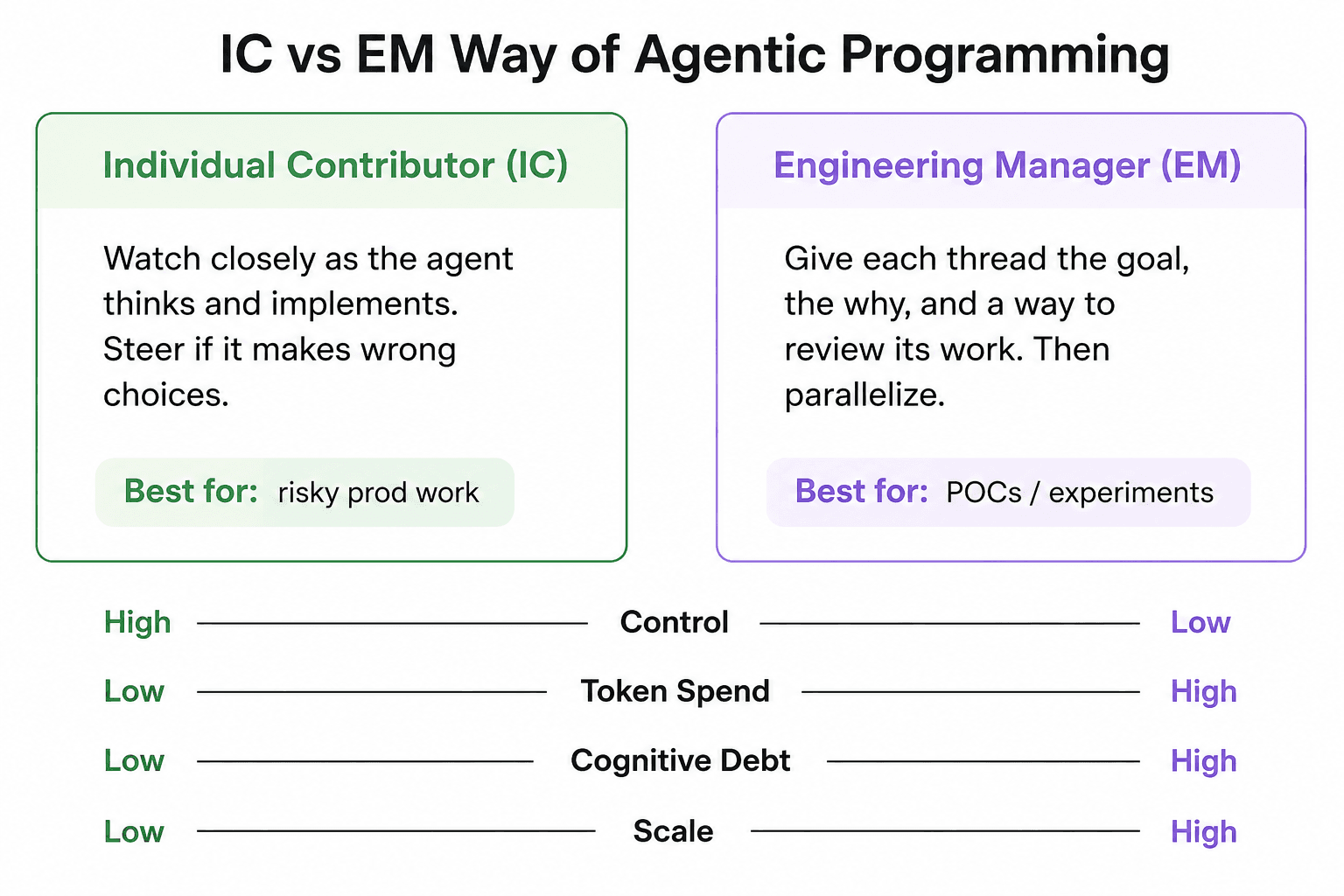
Individual Contributor (IC)
Watch closely as the agent thinks and implements. Steer if they make wrong choices.
Pros
- Token efficient
- Less cognitive debt
Cons
- Scale
As of June 2026, I enjoy using ChatGPT more for the IC way:
- ChatGPT responses are faster than Claude.
- Model overloaded: I have never seen a model overloaded error in ChatGPT. These errors are much more annoying if you are watching a single coding thread, compared to the parallel and async EM way.
- ChatGPT has a steer function that lets you steer the model as it's working, rather than stopping the response and sending a new message.
Engineering Manager (EM)
Stop telling your reports what singular changes to do. Tell them the end goal and the why.
EMs don't review all code changes; they make engineers review each other's code. Many mistakes can be caught by coding agents themselves. I found that reviewing the code in a fresh context works better for this.
You don't have to babysit each thread. Give each thread the goal, the why, and a way to review its work. Then you can parallelize the work and go much faster.
Pros
- Scale
Cons
- Token spend
- Cognitive debt
In June 2026, Anthropic seems to be pushing for this way of coding, especially with the new ultracode function in Claude Code.
You don't have to choose one, you can do both. Like many things in engineering, this is about trade-offs.
For risky and ambiguous production changes, the IC way is a better fit. This way, you have less cognitive debt and debug much easier if something goes wrong. EM mode still works for well-scoped and easy-to-test changes.
The EM way is especially great for experiments, proof of concepts, and hackathons. Especially if your token costs are covered!